
Mt. Rubidoux’ important indigenous history through the documentary “Pá’čapa”
-And why we need to let everyone tell their story and hear them

To get a chance to hear four local Native Americans tell their story of one of the well-known sites in the Inland Empire, Mt. Rubidoux, was a special treat I could not let go by. I know, I usually write about Redlands-related stories but who of us haven’t been hiking up Mt. Rubidoux, pushing strollers, letting the kids climb boulders at the top and enjoyed the view? I have. And I always thought of how random it was that someone carved such wide roads into the mountainsides. Now I know why.
In the basement of the Riverside Medical Clinic the room of Riverside Historical Society’s bimonthly meeting quickly filled up. More chairs were needed. There were easily 100 people present that Sunday afternoon. I wondered if I was the only one visiting from a neighboring city.
This Substack focuses on finding ways to meet your community in a broader sense. Getting to write about lesser known stories, teaches us to connect to our roots and coming to terms with our shared background.
Read along. 

I remember hiking up the wide roads of Mt. Rubidoux pushing a double stroller, later with kids beside me, or friends. The mountain is covered with big rocks and sculptural cacti, low sage brush and a patter of lizards. We admired the bridge crossing the path just before reaching the top, the materials were big sculpted rocks. And we admired the 360 degree views, standing by the flag pole, feeling like standing on top of the world, figuratively and literally. I am embarrassed to say, I didn’t really think of the history of the place. Plaques littering the top explained the view points, some historic male figures who claimed the hill for the City of Riverside. Though when I stood on the boulder away from the monuments, there was a tug inside of me, thinking, imagining who stood here before and what was the views like then? No concrete slabs, no large warehouses and spread out neighborhoods. No downtown Riverside. I remember the warm air, the roughness of the rocks, a scattering of other people looking for the best view. My shadow flowed from my body and over the boulder, spilled into the dirt behind me. All I wished was to fly.
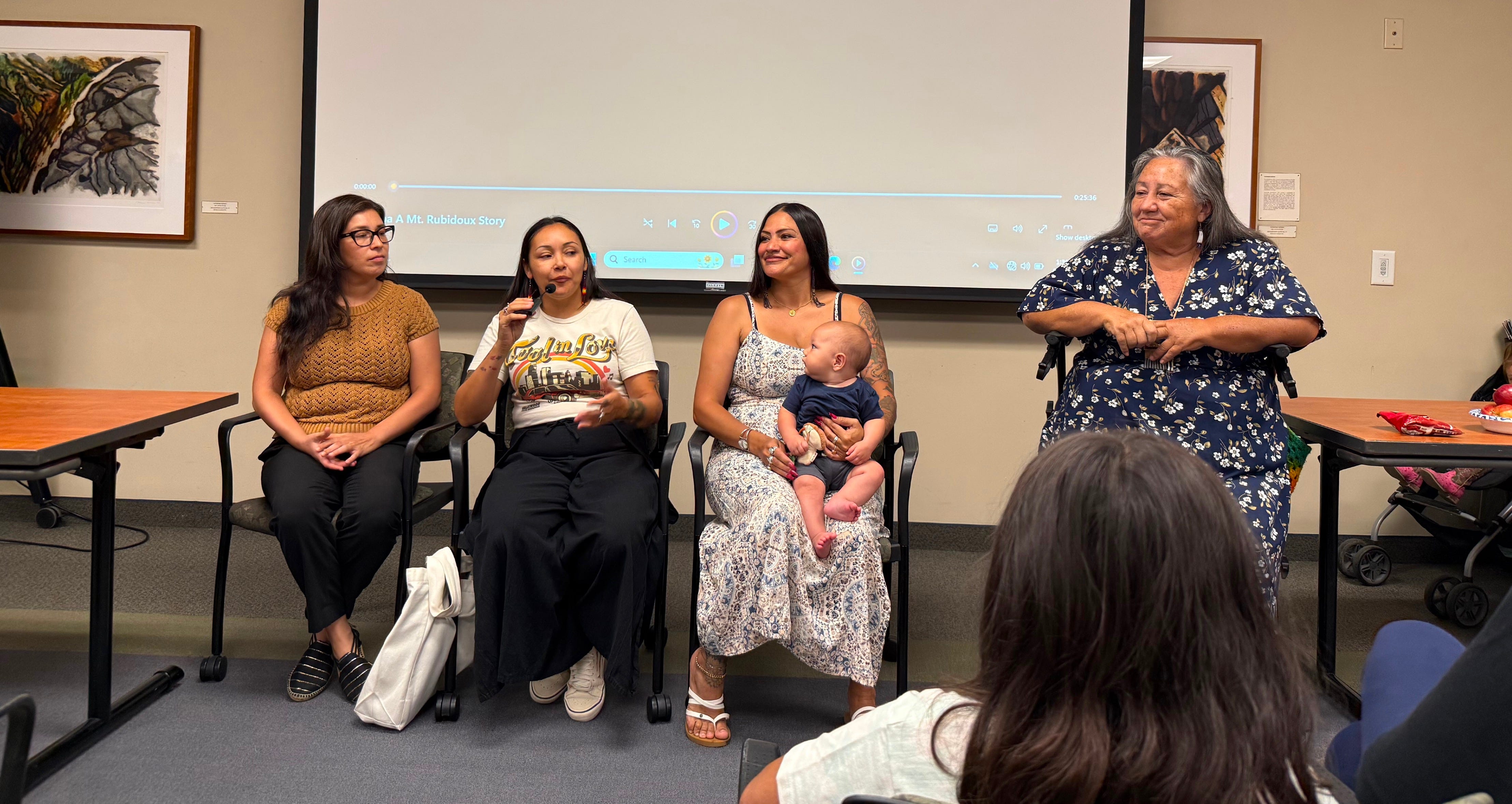
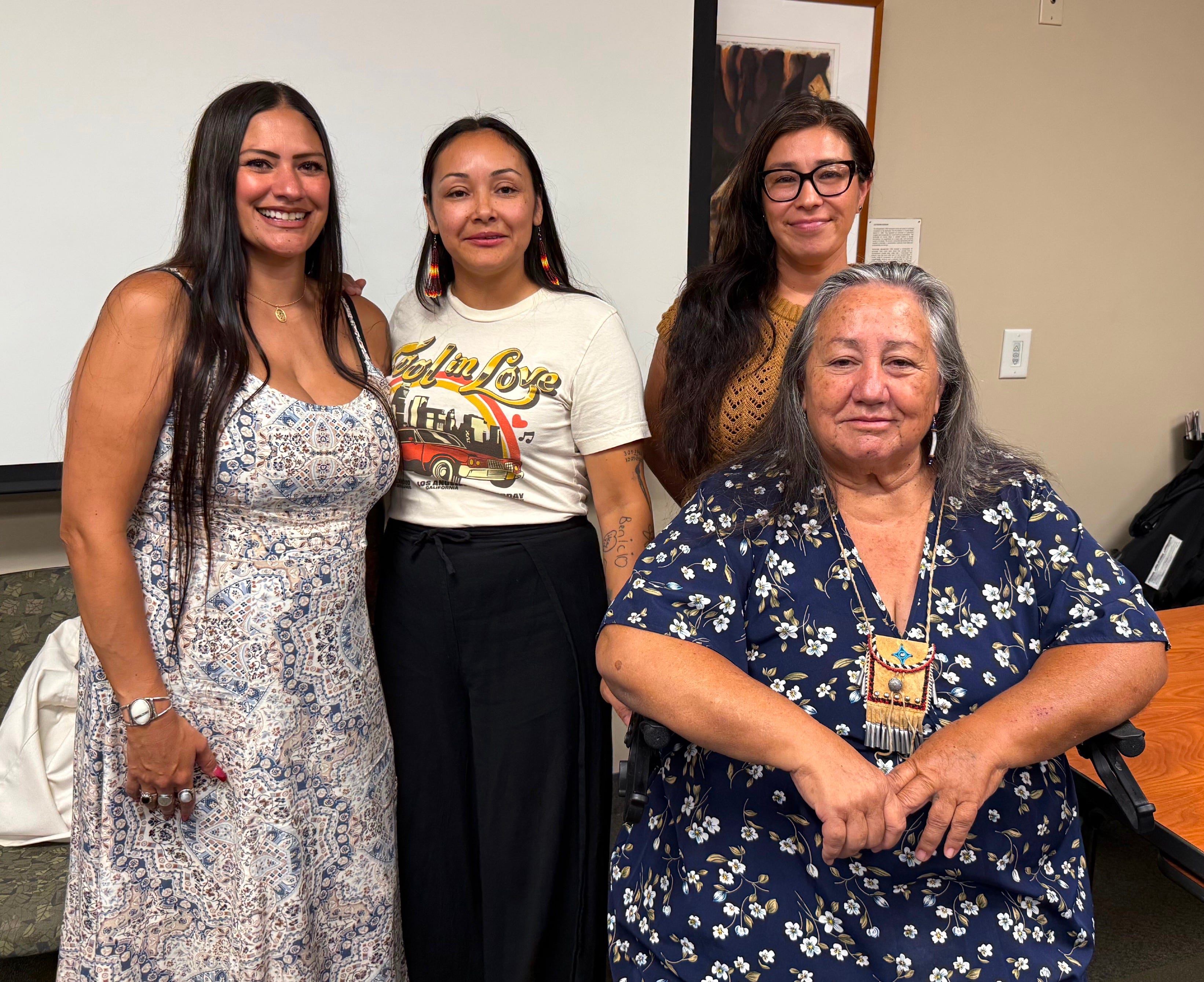
Back in the room, four women sat in front of us: Rosy Aranda, Blossom Maciel, Lorene Sisquoc and Daisy Ocampo. We were about to watch their documentary: “Pá’čapa: A Mt. Rubidoux Story.”
What a stunning piece of art and storytelling! You can watch it here:
According to UCR Arts website, “Through community engagement with tribal communities, the documentary seeks to present the voices of cultural bearers to highlight how Mt. Rubidoux and its surroundings is a sacred native place.”
“There once was a time when the land was wild and free,” began the documentary. “The land was home to the Luiseño, Cahuilla, Serrano and Tongva natives. Their home had a name, a name that had been buried in the past until now.”
We learned that the mountain was sacred, because of its visibility and because it’s a big beautiful natural being. But because of not knowing its true history, it became invisible. The name is not invisible anymore. Pá’čapa means water + where it bends = where the river bends around the mountain.
Mt. Rubidoux1 was first named as such in 1869, with a land survey cementing the name in 1879. Along the river can be found both rock art and grinding holes. Tribal villages surrounded the mountain then. Henry Huntington and Frank Miller looked at how to make wealthy people invest in the area, something called “A Spanish fantasy past” exemplified by the Mission Inn, and they had their eyes on the mountain.
The mountain sides were carved to make automobiles traverse to the top. That way potential investors could look at the magnificent view, get a tour at the Sherman Institute (an off-reservation boarding school where young Indians would perform for them) and visit the Mission Inn in order to fall in love with the area. I watched in dismay at black and white photos, the way the mountain we just heard had an important function for the natives getting brutally mangled to make room for the roads and the cars2. Big rocks were moved, plants pulled, the sides of the mountain would never look the same.
When the filmmakers looked at the historic records of the mountain, they found that a sacrificial rock Indians used worshipping to the sun was supposedly moved to the Mission Inn courtyard, though no rocks matched that when they visited. They pondered whether Frank Miller moved the rock somewhere else or came up with the story all together in order to raise interest as a tourist attraction. There was no doubt that the mountain had a significant history with the Native population, whether the rock had been there or not.
Another tragic consequence in the erasure of Indian culture came with the desecration of burial sites close by Mt. Rubidoux. The area was attractive to built expensive homes, today that street is named Indian Hill Road. In the 19th Century Indians were removed from their tribal lands around Mt. Rubidoux and their villages destroyed3. Native men’s only option was working as ranch hands and as part of labor exploitation in the citrus industry.
“Our history from the beginning of the United States […] wasn’t being told in its true form with the input of Californian people. Along the way settlers and colonialism came and all of that never took the time to listen to the area’s first people,” explained assembly member James C. Ramos in the documentary.
A haunting rendition of a Native song ran along historic photos and documentation.
Ramos emphasized the importance of getting to tell the history and stories of the Native tribes, the impact of the settlers’ decisions, the Natives’ culture and plant life that tied to the local area. “Does the community see now Mt. Rubidoux as a Native American history?” Ramos asked.
The documentary’s message shared the importance of education. To not only share the top layers of history but to get to the bottom layers as well. And with it an understanding of the removal of Native people from their sacred place and to now let them share these stories as a way to reclaim the area.
“Native people did have a clear understanding of property, it may not have been in the form of written deeds and documents […],” said the voiceover in the documentary. “Often times the mechanisms that Native people used to assert claims to land came in the form of songs, sacred songs, ceremonial songs or social songs. Many of these songs include geographical places.”
“The Bird Songs are an archive that store the histories of the Cahuilla people, whispering tales of their ancient struggles, triumphs and the sacred bond between their culture and the natural world, weaving a timeless narrative of resilience and connection”
-Pá’čapa: A Mt. Rubidoux Story
“If clans or families own specific songs, then they are claiming rights to the property.”
Had the settlers asked questions, the Native tribes would have been able to assert their claims to their land, and that ideas about shared spaces needed consent. Today, people using the recreational trails of Mt. Rubidoux, the documentary asked us to think of it as a walk of reference, a kind of pilgrimage and to acknowledge that it’s a spiritual place for local tribes. To give respect to the Serrano, Cahuilla, Luiseno and Tongva people when you reach the top.
When you look at the current plaques at Mt. Rubidoux, who’s story is being told and who’s story is being left out?
“If you want people to embrace [nature], to acknowledge, to preserve and protect a space, they have to understand it fully,” said Cindi Alvitre (Tongva/Gabrielino) in the movie.
“Our oral history has stood the test of time, a testament to our enduring strength,” said the voiceover in the movie.
“The spirit of our ancestors tells us it’s time that our history be told and today we stand in their presence. We are the people of this land, of Pà’čapa.”
-Pá’čapa: A Mt. Rubidoux Story
The film ended with a panoramic view over the mountain and a group of local Native people performing a traditional Bird Song ending with a loud battle cry.
A discussion followed the viewing, local historians and archeologists spoke of the importance of preserving history including the brutal honesty4 about putting Native people in preservations with no water and no resources. And that part of the preservation strategy for Native people was to stay and take jobs offered to them, even though they were exploited.
Blossom explained how it was a privilege to live at the foot of the mountain for two years. “You see that big, beautiful mountain. You feel the power,” she said. Lorene explained their background as descendants from mountain Cahuilla and Apache, growing up in Riverside. Her grandpa’s first cousin explained how his dad had casually said that he grew up in a village at the foot of Mt. Rubidoux. So there were a lot of connections to the area for the filmmakers.
Writing this, I go back and watch the descendants sing and dance their songs on the mountain, connecting their stories, old melodies with feet touching the ground, kicking up dust. Birds communicate by singing, it’s one of the best sounds in the world. Bird Song.
The Riverside Historical Society agreed that something needed to be done for Mt. Rubidoux to recognize the story of the Native people that lived there. There was a call of action from the filmmakers to incorporate these local stories into public education in the Riverside Unified School District even more than they are presently. And in conclusion, we were encouraged to share this story whenever Mt. Rubidoux is mentioned, to tag the local tribes in social media posts when going for a hike there and generally be respectful of the sacred place it is.
Local Native American museums were mentioned as resources of research for the documentary and worth a visit for anyone interested in diving deeper into the layers of history: The Malki Museum in Banning, the brand new Agua Caliente Cultural Museum in Palm Springs, Cupa Cultural Center in Pala and Pechanga Cultural Center in Temecula.
You can learn more about Riverside Historical Society here. Their next meeting is on Sunday, October 5, 2025: Local History Book Fair including a presentation on ‘Women in Riverside 1870-1970’.
Friends of Mt. Rubidoux has the official history here. Notice how native history is missing but now with this documentary hopefully it will be added to their material.
Thank you for reading. If you enjoyed this piece, please like and subscribe, it’s free.
With gratitude, Siw
Rubidoux was named after a Spanish settler, Louis Rubidoux, who came to Agua Mansa in 1844.
Cars stopped driving on Mt. Rubidoux in 1992 because of erosion.
Local Native people lived in the area until 1890. Their descendants are still here as proved by the filmmakers of the documentary.
An older guy described the Agua Mansa Pioneer Cemetery, where victims of a terrible flood in 1862, many were Indians, were buried. “When you go there you can feel the sadness,” he said, “..and death.” The site is surrounded by concrete, logistics centers and construction, with no regards to the history of the place, but there is a small museum there.